
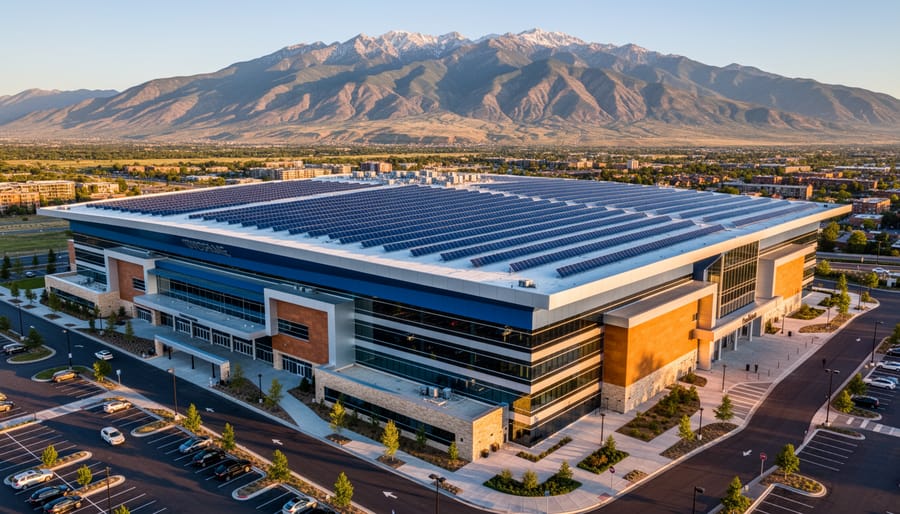
Utah currently prohibits sports betting, making dedicated sports betting facilities non-existent in the state. However, understanding how commercial solar incentives would apply to such facilities remains valuable for Utah business owners exploring renewable energy options for large commercial properties.
If sports betting legislation changes, facilities similar to jonbet apostas would qualify for substantial solar incentives available to all Utah commercial properties. The federal Investment Tax Credit offers 30% back on solar installation costs for commercial projects through 2032, with no cap on system size. Utah’s own Renewable Energy Systems Tax Credit provides additional savings up to $50,000 for commercial solar installations, helping offset initial investment costs significantly.
Commercial property owners can also benefit from accelerated depreciation through the Modified Accelerated Cost Recovery System (MACRS), allowing businesses to depreciate 85% of their solar system costs over five years. This tax advantage dramatically improves return on investment timelines for large-scale installations typical of commercial facilities.
Rocky Mountain Power’s net metering program enables commercial customers to receive credits for excess solar energy sent back to the grid, reducing monthly operating costs. For larger facilities requiring substantial electricity and entertainment venues demand, these credits translate to meaningful long-term savings.
While Utah awaits potential sports betting legalization, commercial property owners can leverage these same incentives today. Warehouses, retail centers, and hospitality venues throughout Utah are already capitalizing on these programs, achieving 40-60% reductions in electricity expenses while contributing to Utah’s clean energy future.
Utah’s Current Sports Betting Landscape
Utah stands as one of only five states in the U.S. where sports betting remains completely prohibited, a position deeply rooted in the state’s legal framework and cultural values. While most states have embraced sports betting following the 2018 Supreme Court decision that overturned the federal ban, Utah has maintained its strict prohibition through both constitutional provisions and state law.
The Utah State Constitution explicitly forbids all forms of gambling, creating a significant barrier that would require voter approval to amend. Additionally, state statutes reinforce this prohibition, making Utah one of the nation’s most restrictive states regarding gambling activities. This means there are currently no legal sports betting facilities, casinos, or gambling establishments operating within the state.
The primary influence behind Utah’s stance stems from the state’s cultural and religious composition. With a majority of the population affiliated with The Church of Jesus Christ of Latter-day Saints, which opposes gambling on moral and social grounds, there has been limited public or legislative momentum to change these laws. This cultural influence extends to the state legislature, where proposals to legalize any form of gambling, including sports betting, have consistently faced strong opposition.
For those researching sports betting facilities in Utah, it’s important to understand this legal landscape means such establishments don’t exist here. However, this doesn’t diminish the value of exploring commercial solar incentives available in Utah. If sports betting were to become legal in the future, or for those interested in solar solutions for other commercial properties, understanding the financial benefits of solar energy remains relevant. Commercial property owners across Utah can take advantage of substantial solar incentives regardless of their business type.
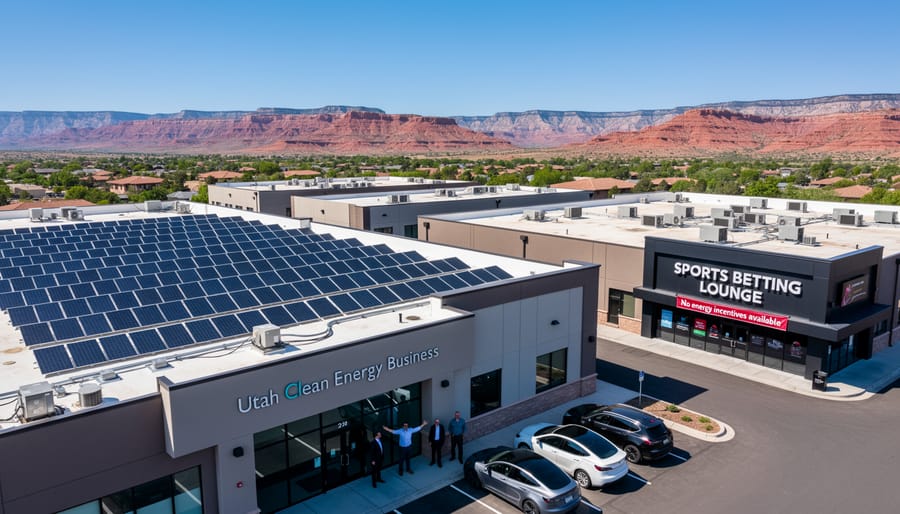
Solar Incentives Available to Commercial Properties in Utah
Federal Tax Credits and Deductions
Commercial solar installations, including those at large entertainment venues, benefit significantly from federal tax incentives that can reduce overall project costs by 30-50%. Understanding these programs helps business owners make informed decisions about solar investments.
The federal Investment Tax Credit (ITC) currently offers a 30% tax credit on the total cost of solar panel systems installed on commercial properties. This means if a facility invests $1 million in solar infrastructure, they can claim $300,000 as a direct credit against their federal tax liability. The ITC applies to all system costs, including equipment, labor, and installation expenses. This credit remains at 30% through 2032, then gradually decreases in subsequent years.
The Modified Accelerated Cost Recovery System (MACRS) provides additional financial benefits through accelerated depreciation. Commercial entities can depreciate 85% of their solar system’s cost over five years, creating substantial tax deductions that improve cash flow during the critical early years of ownership. When combined with the ITC, MACRS allows businesses to recover a significant portion of their investment relatively quickly.
For Utah commercial property owners considering solar installations, these federal incentives work alongside state-level programs to create compelling financial returns. Large facilities with substantial energy needs, such as entertainment venues or sports complexes in states where sports betting is legal, particularly benefit from these programs due to their high electricity consumption and available roof or ground space for solar arrays.
Utah State-Level Incentives
Utah currently offers limited state-level financial incentives specifically for solar energy compared to some neighboring states, but several programs can benefit commercial property owners exploring renewable energy investments.
At the state level, Utah does not currently provide a renewable energy tax credit for commercial installations. However, businesses can still access valuable commercial solar incentives through other mechanisms. Utah’s net metering policy allows commercial solar customers to receive credit for excess electricity their systems generate and send back to the grid. These credits offset future electricity bills at the retail rate, making solar installations more economically attractive over time.
Commercial property owners should note that Utah offers property tax exemptions for renewable energy systems. This means the added value from installing solar panels won’t increase your property tax assessment, reducing the long-term cost of ownership. Additionally, commercial solar systems qualify for accelerated depreciation under federal tax law, allowing businesses to recover costs more quickly.
Rocky Mountain Power, serving most of Utah, provides specific interconnection guidelines and occasional programs for commercial customers. Requirements and timelines vary by location and project size, so early coordination with your utility provider is essential.
While Utah’s state-level incentives are modest, the combination of net metering benefits, property tax exemptions, and federal programs creates meaningful opportunities for commercial solar adoption. Local zoning regulations differ across Utah municipalities, so consulting with your city or county planning department early in the process ensures compliance and helps identify any additional local incentives that may apply to your specific location.
Utility Company Programs
Rocky Mountain Power, Utah’s primary electricity provider, offers several commercial solar programs that can significantly reduce energy costs for large facilities. The Wattsmart Business program provides incentives for energy-efficient upgrades and renewable energy installations, helping offset initial investment costs for commercial solar projects.
One particularly valuable feature for large facilities is Rocky Mountain Power’s time-of-use rate structure. Under this pricing model, electricity costs vary throughout the day based on demand. Sports betting facilities in states where they’re legal typically experience peak activity during evening hours and major sporting events. With solar panels paired with battery storage, facility operators can reduce grid consumption during expensive peak periods by using stored solar energy, leading to substantial savings.
The utility’s demand response programs offer additional financial benefits. These programs compensate businesses for reducing electricity consumption during high-demand periods. Large commercial facilities with solar installations and energy management systems can participate while maintaining operations, creating another revenue stream alongside energy savings.
For facilities considering solar, Rocky Mountain Power’s net metering program allows excess solar generation to be credited against future electricity use. While commercial net metering rates differ from residential programs, they still provide value for businesses producing more energy than they consume during daylight hours.
Other municipal utilities throughout Utah may offer distinct incentive programs, so it’s worthwhile to check with your local provider. These utility incentives, combined with federal tax credits and state programs, create a compelling financial case for commercial solar investment across Utah’s business landscape.
Why Sports Betting Facilities Would Be Ideal Solar Candidates
Sports betting facilities and casinos operate unlike typical commercial buildings, creating unique opportunities for solar energy solutions. Understanding their energy patterns helps explain why these establishments would benefit significantly from solar installations.
These facilities maintain 24/7 operations with consistently high electricity demands. Large-scale gaming floors require extensive lighting, climate control systems running continuously, and hundreds of electronic gaming machines and screens operating simultaneously. Security systems, surveillance equipment, and data centers processing real-time betting information add to the baseline energy consumption. Air conditioning systems work overtime to counteract heat generated by electronics and crowds, particularly during peak betting periods around major sporting events.
Nevada’s casinos provide the clearest example of how solar addresses these demands. Several Las Vegas properties have installed large rooftop and parking canopy solar arrays, reducing their substantial utility bills while maintaining uninterrupted operations. The Mandalay Bay Convention Center, for instance, operates one of the largest rooftop installations in the country, demonstrating how entertainment venues can offset their considerable energy costs.
Colorado sports betting establishments have similarly embraced solar technology since legalizing sports wagering. Several casinos near the Utah border have installed solar systems, taking advantage of Colorado’s solar incentives while managing their electricity expenses. Arizona’s tribal gaming facilities have also invested in solar infrastructure, with some properties achieving significant energy independence through combined solar and battery storage systems.
The financial logic remains compelling. With electricity representing one of the largest operational expenses for these facilities, solar installations dramatically improve the solar payback period. Continuous daytime operations mean immediate energy consumption during peak solar production hours, maximizing system efficiency. Large roof areas and expansive parking lots provide ideal installation space without requiring additional land purchases.
For Utah commercial property owners considering similar operations, these examples demonstrate how high-consumption facilities can achieve substantial long-term savings through strategic solar investments.
What Other States’ Sports Betting Facilities Are Doing
Looking beyond Utah’s borders, several neighboring states offer valuable lessons about how large entertainment venues have successfully integrated solar energy. These examples demonstrate the financial and environmental benefits that commercial facilities can achieve through solar installations.
In Nevada, the Red Rock Casino Resort and Spa in Las Vegas installed a massive 1.3-megawatt solar array that generates approximately 2 million kilowatt-hours annually. This system reduces the property’s electricity costs by roughly $300,000 each year while offsetting over 1,400 tons of carbon dioxide emissions. The facility took advantage of Nevada’s commercial property tax abatements and federal Investment Tax Credit, which covered 30% of the installation costs. The project demonstrates how entertainment venues with large roof spaces and parking areas can transform underutilized surfaces into revenue-generating assets.
Arizona’s Desert Diamond Casino in Tucson provides another compelling case study. Their 1-megawatt solar installation covers parking structures and produces enough electricity to power approximately 150 homes annually. The facility leveraged Arizona’s commercial solar tax credits and accelerated depreciation benefits, achieving a payback period of just seven years. Casino management reported annual savings exceeding $180,000 on electricity costs, with those savings increasing as utility rates rise.
Colorado’s commercial properties have also embraced solar energy through the state’s robust incentive programs. While specific sports betting facilities are newer to Colorado’s market, established casinos in Black Hawk and Central City have implemented solar arrays ranging from 500 kilowatts to over 1 megawatt. These facilities typically see 20-30% reductions in annual energy costs and benefit from Colorado’s sales tax exemptions on solar equipment, which can represent substantial upfront savings on large commercial installations.
These examples illustrate a consistent pattern: entertainment and hospitality venues with high energy demands and available space can achieve significant financial returns while reducing their environmental footprint through strategic solar investments.
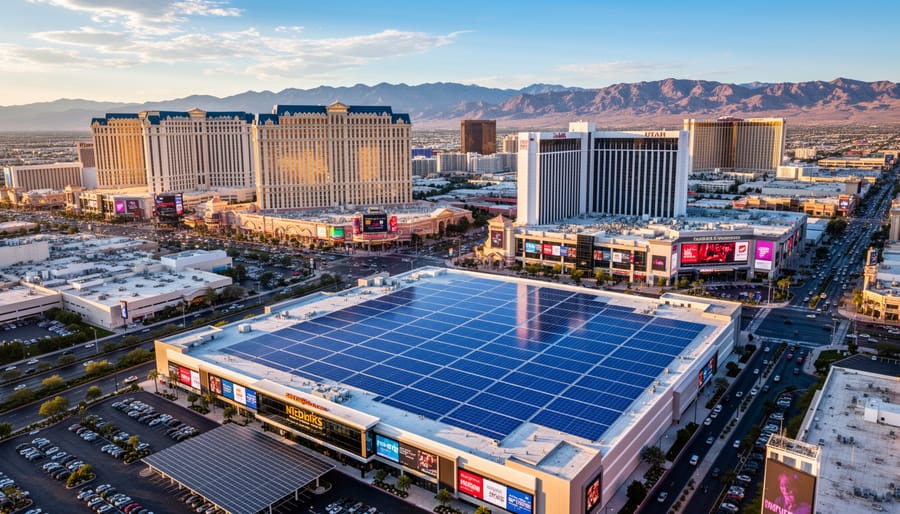

The Path Forward: If Utah Were to Legalize Sports Betting
If Utah’s legislature were to legalize sports betting in the future, these facilities would integrate seamlessly into the state’s existing commercial solar framework. Understanding how this would work helps illustrate Utah’s robust support for renewable energy across all business types.
Sports betting facilities would follow the same commercial solar pathways available to other businesses today. They’d qualify for the federal Investment Tax Credit, which currently provides a 30% credit on solar installation costs. Utah’s commercial solar programs don’t discriminate by business type, meaning a sportsbook would access the same incentives as restaurants, retail stores, or office buildings. Property owners considering rooftop solar for businesses would find consistent support regardless of their industry classification.
Local zoning would play a significant role in implementation. Counties and municipalities would need to classify sports betting facilities within their codes, typically as entertainment or commercial venues. This classification determines building requirements, including where solar panels can be installed and how permits are processed. Most Utah communities have established procedures for commercial solar installations that assess structural load capacity, setback requirements, and visual impact considerations.
Building permit requirements would mirror those for any commercial solar project. Applicants would submit plans to local building departments showing electrical diagrams, structural engineering calculations, and interconnection agreements with their utility provider. The process typically takes four to eight weeks, depending on the jurisdiction and project complexity.
Rocky Mountain Power’s net metering program would accommodate these facilities just as it does for current commercial customers. The utility’s Schedule 135 allows businesses to offset electricity costs with solar generation, crediting excess production at retail rates. This framework already exists and would automatically extend to legally operating sports betting venues without requiring new infrastructure or policy changes.
Utah offers exceptional solar incentive programs for commercial properties, yet the irony remains clear: sports betting facilities cannot take advantage of these benefits simply because they are not legally permitted to operate in the state. While this specific combination of sports betting and solar incentives remains unavailable, the broader message is encouraging for Utah business owners in other industries.
If you own or manage a commercial property in Utah, now is an ideal time to explore solar energy solutions. The state’s robust incentives, combined with federal tax credits and various financing options, make commercial solar installations increasingly accessible and cost-effective. Local zoning regulations generally support solar development, and regional financial programs continue to make renewable energy a smart investment for businesses across diverse sectors.
As for sports betting facilities specifically, legislative landscapes can shift. Staying informed about potential changes to Utah’s gaming laws could prove valuable for those interested in this industry. For now, focus on what’s available: Utah’s solar programs remain among the most beneficial for eligible commercial operations throughout the state.

